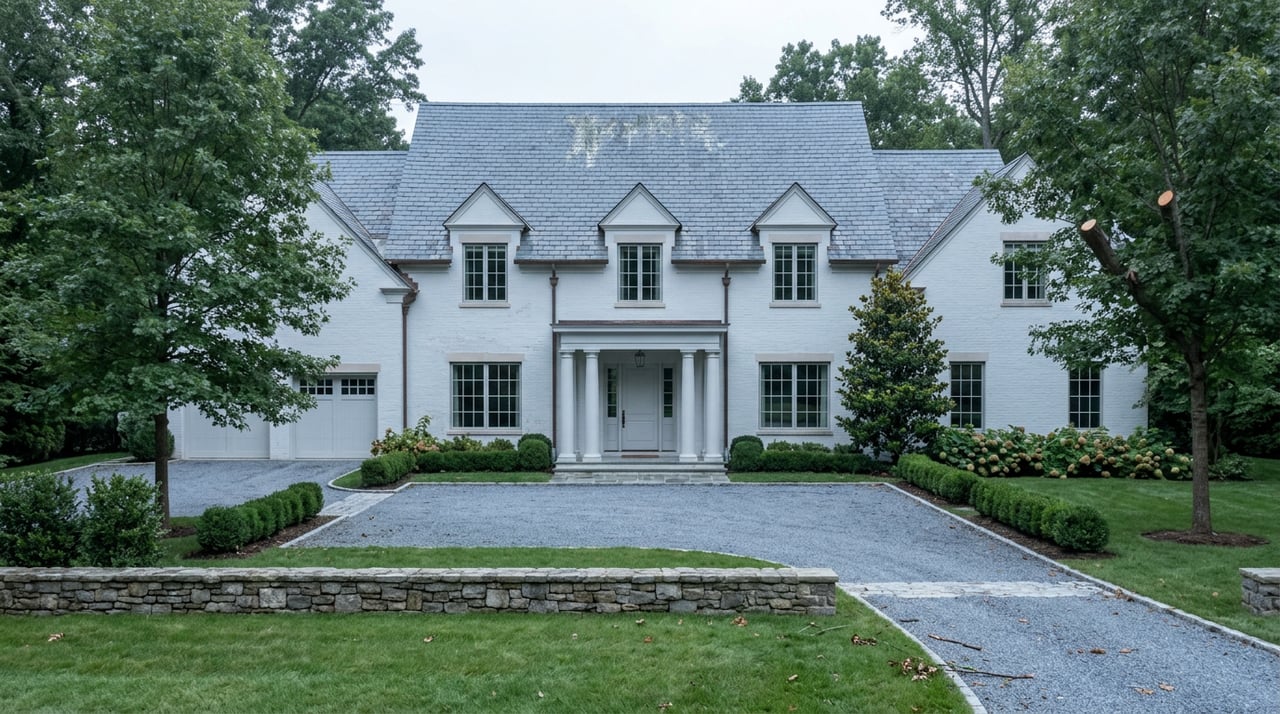
Oak Hill Has No Downtown. This Year, Its Biggest Fight Was Over Fences.
September 3, 2026
September 3, 2026
Drive through most Nashville suburbs this summer and the story is a restaurant opening, a road diet finally finished, or a farmers market moving to a new lot. Drive through Oak Hill and none of that applies, because none of it exists. The city has no commercial district to speak of. There is no strip to watch for a new lease sign, no corner bar tracking its first anniversary. What Oak Hill has instead is trees, fences, and the ground underneath its own streets, and this year all three became the thing residents actually argued about.
That is not a small distinction. In a city that cannot legally grow a Main Street, the fights that would normally play out over zoning a restaurant or approving a strip mall get displaced onto yards and canopy instead. Understanding Oak Hill this year means understanding that its civic energy went somewhere specific: a storm that took down old trees, an ordinance fight over what replaces the privacy those trees provided, and a single boulevard that stayed closed for five weeks.
Oak Hill was incorporated in 1952, before Nashville and Davidson County merged into the Metro government that surrounds it today. That timing matters because it means Oak Hill exists as its own satellite city inside Metro, with its own Board of Commissioners handling planning, land use, and zoning while Metro handles everything else. The city's own government page states the point plainly: it is completely residential, with no commercial establishments at all. What it has instead, within roughly eight square miles and about 1,800 homes, is the Tennessee Governor's Residence, fifteen churches, a handful of schools, and a share of Radnor Lake, the 1,200-acre natural area that ranks as Tennessee's largest.
That combination, no storefronts but a working state landmark and a share of the region's best-known nature preserve, produces a city where the built environment barely changes and the natural one does all the talking. Which is exactly what happened this year.
The ice storm that hit Middle Tennessee on January 24 and 25 left up to three-quarters of an inch of ice on branches and power lines, according to reporting that named it Winter Storm Fern. Nashville Electric Service logged a record 230,000 simultaneous outages at the height of the event, the largest in the utility's history. Citywide, Mayor Freddie O'Connell later put the toll at more than 2,000 trees destroyed and over 1.4 million cubic yards of debris collected by Metro crews, a figure he expected to approach 2 million as cleanup continued.
Oak Hill's canopy took a direct hit. The Nashville Department of Transportation singled it out, along with Madison and Sylvan Park, as one of the areas needing multiple special collection passes to clear the wood piling up at curbs. The Nashville Tree Foundation later named Oak Hill specifically among the areas that saw scores of old growth trees toppled under the ice, in the same breath as Bellevue, Donelson, and Brentwood. For a city whose entire identity rests on mature lots and heavy tree cover rather than commercial square footage, that is not incidental damage. It is damage to the one asset the city was built around.
The cost showed up on Oak Hill's own books. By its April Board of Commissioners meeting, the city manager reported that storm response and cleanup costs would exceed the $1 million the board had already approved transferring from reserves into the general fund, forcing a second budget amendment. The board passed that transfer unanimously on first reading in March and took it up again for a public hearing at the April 28 meeting.
Homeowners handling their own tree damage faced a separate risk. The Tennessee Attorney General's office issued a consumer alert after complaints rose about door-to-door crews demanding cash upfront and then never finishing the work, including one Nashville homeowner who lost more than $6,000 this way. Robyn Householder, president of the Better Business Bureau of Middle Tennessee, put the warning sign simply: "Anything beyond fifty percent should be a red flag." For a city with no shortage of large, tree-heavy lots and no municipal tree-removal program of its own, that is worth remembering the next time a bucket truck shows up unannounced.
Damaged canopy raises an obvious follow-up question in a city like Oak Hill: once the tree cover thins, what replaces the privacy it provided? The Board of Commissioners had already been wrestling with that question for the better part of a year before the storm, in the form of a proposed rewrite of the city's fence ordinance modeled directly on the existing code in neighboring Forest Hills.
The debate split into three camps, and none of them were arguing about commerce or density. They were arguing about what an open-lot residential city owes its own character.
After several meetings generating what the city itself described as considerable public comment, a new draft ordinance went back to the board for consideration at the April meeting, alongside a related look at how fence and conditional use permit procedures divide authority between the Board of Zoning Appeals and the Planning Commission. There is no storefront vacancy to debate in Oak Hill. There is only what a homeowner is allowed to build at the edge of their own lot, and this year that question carried the weight a zoning fight over a new restaurant might carry somewhere else.
The other disruption residents felt directly this spring had nothing to do with trees or ordinances. Beginning April 20 and running through May 25, the city posted a full 24-hour closure on Tyne Boulevard near 881 Tyne Blvd, driven by excavation work exceeding 12 feet deep, too deep to bridge safely with temporary steel plates for through traffic.
In a city built around a small number of connecting roads rather than a commercial grid with alternate routes, a five-week full closure on a boulevard like Tyne is not a minor inconvenience. It is the kind of disruption that gets discussed at every mailbox for a month, precisely because there is no parallel retail corridor to absorb the detour traffic the way there might be in a denser neighborhood.
None of this happens in a vacuum. Oak Hill's Board of Commissioners, currently Mayor Dale Grimes, Vice Mayor Winston Evans, and Commissioners Scott Price, David DeMarco, and Joy O'Dell, meets at 6 p.m. on the fourth Tuesday of every month, with meetings livestreamed for residents who cannot attend in person. The board also settled a piece of litigation with Churchill Properties at no cost to the city this spring and carried a proposed 2026-27 budget of $3,440,381 in balanced revenue and expenditure into the fiscal year that began July 1, a plan that spends down the last of the city's one-time federal pandemic relief funds.
That is a small budget for a small city, but it is also the entire mechanism by which Oak Hill absorbs a year like this one. There is no development fee from a new commercial project to offset storm costs. There is no sales tax bump from a busy retail corridor. There is only the reserve fund, the board's willingness to draw from it, and residents willing to sit through a public hearing about fence height.
That is the real shape of life in Oak Hill this year. Not a restaurant opening or a trail reroute, but a canopy that took a hit, a fence ordinance that tried to answer for it, and a boulevard that stayed closed long enough for everyone to notice. A city with no storefronts still has to decide what it protects and how, and this year it decided that mostly meant trees, fences, and the ground beneath its own streets.
If you already call Oak Hill home and want a clearer read on what any of this means for your own property, from tree canopy considerations to how the fence ordinance might eventually apply to your lot, Beth Molteni has spent decades working in Nashville's established residential neighborhoods and is glad to talk through what you're seeing on your own street.
Stay up to date on the latest real estate trends.
Etiam non quam lacus suspendisse faucibus interdum. Orci ac auctor augue mauris augue neque. Bibendum at varius vel pharetra. Viverra orci sagittis eu volutpat.
Beth Molteni
3825 Bedford Ave Ste 102 Nashville TN 37215